Jensen Huang, Hinton, and LeCun Sat at One Table. Here's What They Said About the AI Bubble
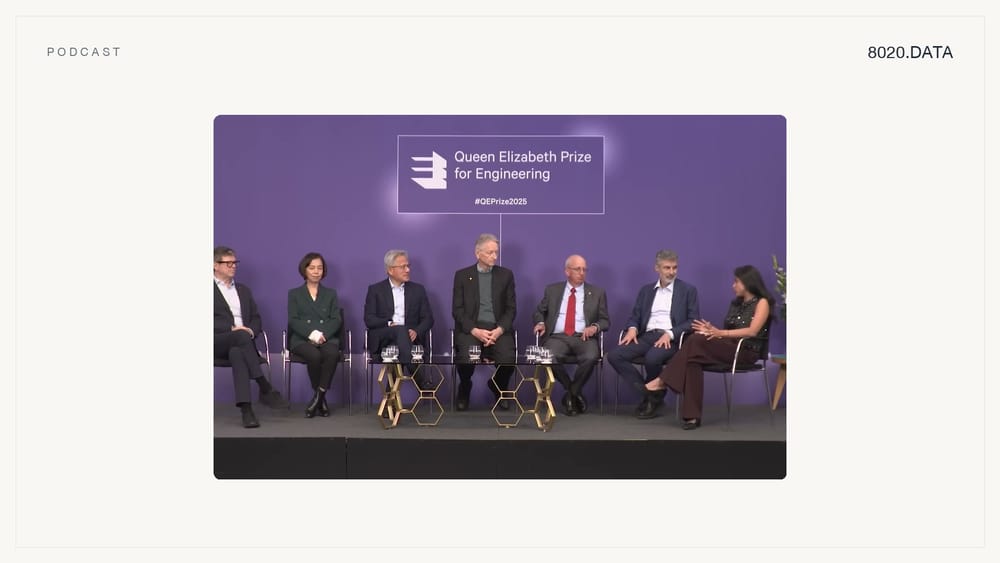
On 6 November 2025, six of the people who actually built modern AI sat together for the first time in history. The 2025 Queen Elizabeth Prize for Engineering laureates assembled at the FT Future of AI Summit in London for a 35-minute panel — and what came out of it was less a celebration of past achievements than a public disagreement about what comes next.
This episode of the 8020 Data podcast unpacks what was said and why it matters for anyone running a data or AI initiative right now.
🎧 Listen to the Episode
English version
Arabic version
English audio: ~19 minutes. Arabic audio: ~23 minutes. Key takeaways are below.
Who Are the Six?
| Name | Role today | Famous for |
|---|---|---|
| Jensen Huang | Founder & CEO, NVIDIA | The GPU compute platform that the entire deep-learning era runs on |
| Geoffrey Hinton | “Godfather of AI” | Backpropagation and deep neural networks (since the 1980s) |
| Yann LeCun | Chief AI Scientist, Meta | Convolutional neural networks (CNNs) |
| Yoshua Bengio | Université de Montréal — now leading AI safety research | Deep learning theory |
| Fei-Fei Li | Stanford HAI Institute | ImageNet — the dataset that triggered the 2012 deep-learning revolution |
| Bill Dally | Chief Scientist, NVIDIA | Parallel-compute architecture |
(The seventh laureate, John Hopfield, was not at the panel.)
The Story in One Line
The first half of the panel was about the past — how each of them got here. The second half was about the future — three big questions, with strikingly different answers from people who, in theory, should agree.
The Three Big Debates — And Where the Six Disagree
1. Are we in an AI bubble about to burst?
Jensen Huang’s case for “no” — and the structural argument behind it:
"During the dot-com bubble, the vast majority of the fiber deployed was dark*. Today, almost every GPU you can find is lit up and used."*
But Huang’s deeper argument isn’t statistical — it’s structural. Past software was pre-compiled and retrieved on demand. AI must be generated in real time, contextually. You can’t produce intelligence in advance and pull it off a shelf. This means the industry needs a new asset class — what he called “factories that produce intelligence”:
“AI needs factories. We need hundreds of billions of dollars of these factories to serve the trillions of dollars of industries that sit on top. For the first time in history, the computer is part of a factory.”
The crucial reframe: previous software was a tool used by people. AI is intelligence that augments people — so the addressable market is the entire labor economy, not just the software market.
Bengio’s counter-frame: “Stop calling them LLMs. They start as language models, but recently they’ve become agents.” The technology is changing fast enough that nobody should be predicting its shape in 2, 5, or 10 years. We should track trends and risks instead.
2. Are tech valuations justified?
Bill Dally’s three-trend argument:
- Models are getting more efficient. Attention → grouped-query attention → multi-head latent attention. Same or better results with far less compute. Cheaper compute creates new demand.
- Models are getting better. Maybe transformers continue to improve, maybe a new architecture emerges. Either way, “we won’t go backwards.”
- Applications have barely begun. “I think we’ve started to reach maybe 1% of the ultimate demand for this.”
Conclusion: “We’re riding a multiple exponential, and we’re at the very beginning of it.”
Fei-Fei Li’s scientific framing:
“AI is less than 70 years old. Physics is more than 400. There are far more new frontiers to come.”
She’s now working on what she calls spatial intelligence — perception fused with action — and notes that “even today’s most powerful LLM-based models fail at rudimentary spatial intelligence tests.” The real scientific frontier is much wider than LLMs.
LeCun’s split verdict — the most cited line of the panel:
“There are a lot of applications to develop based on LLMs — that justifies the investment. The bubble is in the idea that the current paradigm of LLMs will be pushed to the point of having human-level intelligence — which I don’t believe in.”
“We don’t have robots that are nearly as smart as a cat. We’re missing something big still — and that’s a scientific question, not a question of more infrastructure, more data, more investment.”
3. How long until human-level AI?
This is where the disagreement was widest:
| Speaker | Their view |
|---|---|
| Bengio | “It’s not going to be an event.” Capabilities expand progressively across domains. ~5–10 years to make significant progress on a new paradigm. |
| Fei-Fei Li | “Part of it is already here.” How many adults can recognize 22,000 object categories or translate 100 languages? “Airplanes fly, but they don’t fly like birds.” Parts of machine intelligence will surpass humans; parts will never resemble human intelligence at all. |
| Jensen Huang | “We have enough general intelligence today to translate the technology to an enormous amount of society-useful applications. We’re already there. The answer is — it doesn’t matter. It’s an academic question.” |
| Hinton | “If you refine the question to: how long before a machine always wins a debate with you? Definitely within 20 years, probably less.” |
| LeCun | Disagrees with the augment-only framing on principle: “I don’t see any reason why we wouldn’t be able to build machines that can do pretty much everything we can do.” The data point that should worry/excite you: AI’s planning horizon for engineering tasks has grown exponentially over the last 6 years. Extrapolating that trend, AI hits employee-level performance on engineering tasks within ~5 years. The wildcard: AI doing AI research could compress every other timeline. |
The host’s closing synthesis: “The future is here today, but there’s never going to be one moment.”
What This Means for Data and AI Leaders Right Now
Three takeaways from the 8020 Data lens:
1. Don’t architect on the assumption that LLMs are the ceiling.
Bengio, LeCun, and Fei-Fei Li are saying the same thing from three different angles: what we have today is not the endpoint. Spatial intelligence is missing. Agents interacting with environments are immature. New architectures are coming. If your data infrastructure is wired specifically to serve today’s LLM applications — and only those — you’re building on ground that will shift in 24 months. Build a data architecture that survives a paradigm change. The prompts will evolve. The pipelines, governance, and semantic layer should not need to be rebuilt every time.
2. “AI needs factories” really means: your data is the actual R&D.
Huang’s reframe exposes the economic truth most boards still haven’t internalized. The value of AI is generated in the moment — from the data you feed into it — not from a model you license. So the strategic question is no longer “which model do we use?” (every competitor has access to the same models). The question is: “what unique, clean, trustworthy data do we have that will make this model produce a better answer than our competitor’s instance of the same model?” This is where competitive moat is built. Models converge. Data differentiates.
3. The AGI debate is not your problem. The gap between capability and adoption is.
Huang is right: “the answer is, it doesn’t matter.” Whether AGI arrives in 5 years or 20, the capability available today is already orders of magnitude beyond what most companies are using. Don’t wait for AGI to start. Ask the smaller, sharper questions:
- What decision in your business takes 2 hours of human review and could be drafted by an AI trained on your data in 30 seconds?
- Where in your reporting cycle do humans assemble information that an AI agent could pre-compose?
- Which of your manual data-cleaning steps is a human doing because “that’s how it’s always been done” — and could be automated this quarter?
The gap between “what AI can do” and “what your organization actually uses AI for” is where every percentage point of margin will be made for the next 5 years.
Where This Episode Came From
This episode is based on the original FT Live panel, “The Minds of Modern AI”, recorded at the FT Future of AI Summit in London on 6 November 2025. The panel was hosted by Madhumita Murgia, AI Editor at the Financial Times.
Watch the full panel (35 min, English): The Minds of Modern AI — FT Live
What’s Your Take?
Which scenario do you side with — are we in a bubble, or at the start of a build-out? Reply to this post, or subscribe to the newsletter to get every new episode and analysis delivered.
Planning an AI Initiative?
If you’re navigating large architectural decisions and want a second opinion before committing significant budget, book a 30-minute diagnostic — free, direct, no slide deck.
Not sure if your data is AI-ready?
A data architecture assessment will show you exactly what needs fixing.
Book a Call →