AI Amplifies Clarity. It Also Amplifies Chaos. Which One Lives in Your Data?
Why the AI layer on your analytics will either be your best investment or your most expensive mistake
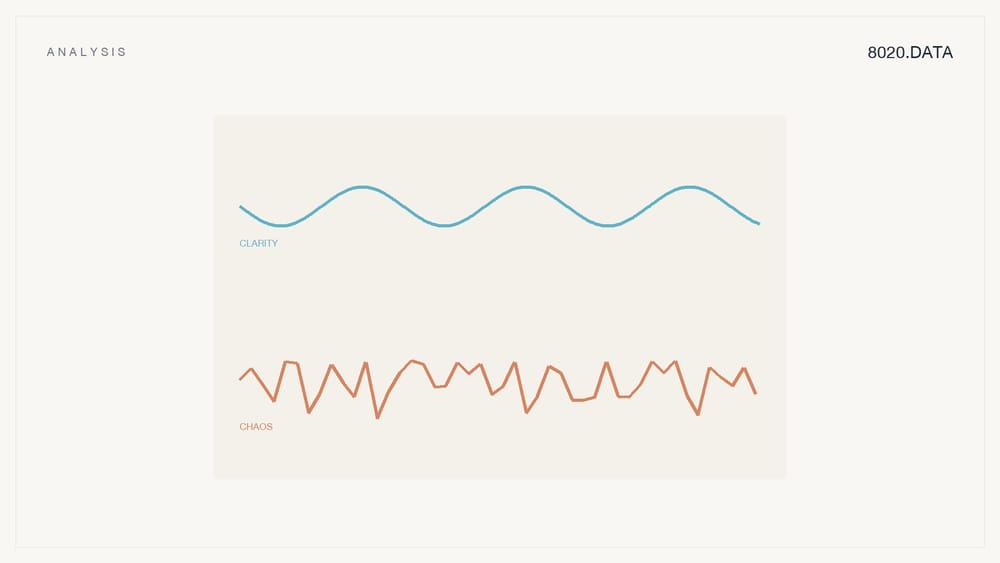
A recent Ardoq piece on context engineering makes the core point cleanly: AI amplifies whatever organizational context you give it. Clear, well-architected context compounds returns. Fragmented context compounds dysfunction.
That idea is the most accurate description I've seen of what happens when companies add AI to broken data.
The Loudspeaker Problem
AI is neutral. It has no preference for truth or falsehood. It doesn't know if the number it's producing is right or wrong. It processes what it's given and presents the output with equal confidence regardless of the input quality.
This makes AI a loudspeaker, not a filter.
Point a loudspeaker at a clear signal — a well-modeled dataset with tested definitions and documented logic — and it broadcasts clarity. Revenue insights in seconds. Anomaly detection that catches real problems. Natural language answers that leadership can act on. This is the AI promise that vendors sell in every demo.
Point that same loudspeaker at noise — raw data with duplicate definitions, untested logic, and five different versions of "revenue" — and it broadcasts confusion. Loudly. Confidently. To the CEO, in a board meeting, with a chart that looks professional and a number that's wrong.
The loudspeaker doesn't care what it's amplifying. That's your job.
Why AI Makes Bad Data More Dangerous
Before AI entered the analytics stack, bad data was a slow-moving problem. Wrong numbers sat in reports that nobody opened. Flawed logic hid in SQL queries that one person maintained. Data quality issues surfaced once a quarter — usually when the CFO noticed something off in a financial review.
The damage was real, but the blast radius was small. Bad data had limited distribution.
AI changes the blast radius.
With AI-powered analytics, bad data gets surfaced instantly. To anyone who asks. The CEO types "What was our customer acquisition cost last month?" and gets an immediate, confident, beautifully formatted answer. There's no human intermediary to say "wait, let me check that number." There's no analyst who notices the calculation looks off. The AI answers the question with the same authority whether the underlying data is pristine or garbage.
And here's the part that makes it dangerous: AI doesn't have a "confidence warning." A human analyst might hedge — "this number looks unusual, let me verify." An AI model states a wrong answer with the same tone as a right one. There's no asterisk. No doubt. No "by the way, the revenue definition in your staging table doesn't match the one in your mart layer."
This means AI doesn't just reproduce data quality issues — it promotes them. It takes errors that used to live in the back office and puts them on the executive dashboard. In real time. With a polished interface.
The Two Realities
I've seen both sides of this play out with companies in the GCC.
Reality A: Signal
A company that invested in their data architecture before adding any AI layer. They built a dbt project with staging, intermediate, and mart layers. Every metric is defined once. Business logic is tested automatically — revenue is never negative, primary keys are unique, date ranges are valid. Every definition is documented.
When they added an AI analytics layer, the results were immediate. The CEO could ask natural language questions and get accurate answers. The finance team used AI-generated summaries to prepare for board meetings in half the time. Anomaly detection caught a data integrity issue — an order status contradiction — before anyone noticed it manually.
AI amplified what was already there: clarity.
Reality B: Noise
A company that skipped the architecture and went straight to the AI demo. They connected their AI analytics tool directly to the ERP and a handful of Excel files. No transformation layer. No shared definitions. The sales team defined "revenue" one way. Finance defined it another. Nobody documented either definition.
The AI tool worked perfectly — technically. It ingested the data, processed the queries, and delivered beautiful answers. The problem was that the answers contradicted each other depending on which data source the AI pulled from. The CEO got a revenue number that was 15% higher than what the CFO reported. When asked to explain the difference, nobody could — because nobody knew which definition the AI was using.
Within two months, the AI tool was shelved. Leadership reverted to manual reports. The company's trust in data — not just in AI, but in all data — dropped lower than before the project started.
AI amplified what was already there: chaos.
The Architecture Test
Before investing in any AI analytics tool, there's a simple test. I call it the signal-or-noise test.
Ask your team three questions:
1. "If two people ask for the same metric right now, will they get the same number?"
If yes — your definitions are centralized. You have signal. AI will amplify it.
If no — your definitions are fragmented. You have noise. AI will amplify it.
2. "If a data quality issue appeared today, how long before we'd notice?"
If the answer is "our tests would catch it before any dashboard updates" — you have signal.
If the answer is "probably when someone complains in a meeting" — you have noise.
3. "Could a new team member understand how any metric is calculated by reading documentation?"
If yes — your context is transparent. AI can read the same documentation and operate reliably.
If no — your context lives in someone's head. AI can't read minds, and neither can the next person who joins your team.
Three "yes" answers: your data is ready for AI. The loudspeaker will broadcast clarity.
Any "no" answer: fix the architecture first. Otherwise you're paying for a loudspeaker to broadcast static.
The Order of Operations
The companies that succeed with AI analytics all follow the same sequence. Not because it's trendy, but because it's the only sequence that works:
Step 1: Build the data model. Define every key metric in code. Revenue, active customers, churn, order status, acquisition cost. One definition each. Tested. Documented. Version-controlled.
Step 2: Create the transformation layer. Raw data flows through staging → intermediate → mart. Each layer adds structure and reliability. By the time data reaches any consumer — human or AI — it's been validated.
Step 3: Test before serving. Automated tests run every time the data updates. If a test fails, the pipeline stops. Nobody sees bad data. Not a dashboard. Not an AI agent. Not a report.
Step 4: Add the intelligence layer. Now — and only now — connect the AI tool. Whether it's natural language querying, anomaly detection, automated reporting, or predictive insights. The AI reads from a single, tested, documented source of truth. It amplifies clarity because clarity is all that's there to amplify.
Skip steps 1-3 and jump to step 4, and you'll join the majority of companies where AI analytics "didn't work." It worked fine. The data underneath it didn't.
Signal Compounds. Noise Compounds Too.
The final dimension is time. With a solid architecture, AI gets better the more data flows through it. Patterns become clearer. Anomaly baselines get more accurate. Predictions improve. Signal compounds.
With a broken architecture, AI gets worse over time. More data means more contradictions. More contradictions mean more confident wrong answers. More wrong answers mean less trust. Noise compounds too — it just compounds in the wrong direction.
The choice isn't between "AI now" and "AI later." The choice is between "signal now" and "noise now." One leads to compounding clarity. The other leads to compounding chaos.
AI is a loudspeaker. It amplifies whatever you point it at. If your data architecture is signal, AI will be the best investment you make this year. If it's noise, AI will be the most expensive. The loudspeaker doesn't care. Your data model decides.
Not sure whether your data is signal or noise? Take the 2-minute AI Readiness Quiz to get your score, spot the biggest gaps, and see what AI would actually amplify in your stack.
Not sure if your data is AI-ready?
A data architecture assessment will show you exactly what needs fixing.
Book a Call →